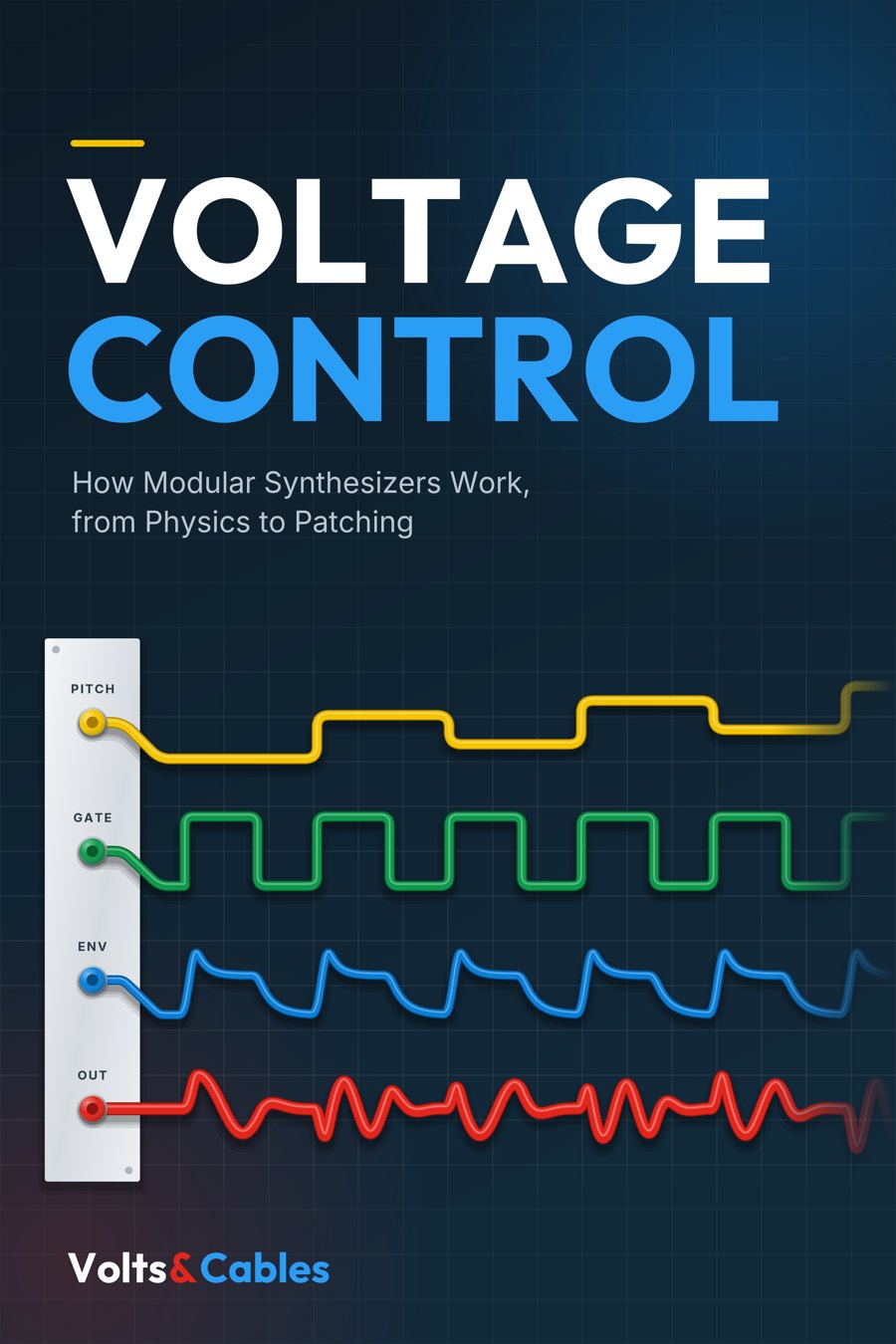
Most synthesizers, hardware or plugin, are built from the same few blocks (oscillators, filters, amplifiers, envelopes and LFOs), wired together in advance. A modular, today usually a Eurorack system, leaves the wiring to you, with cables that carry voltages. This book teaches you to patch it and to hear what each cable does. Even if you never buy one, you will read your own synths’ panels better.
It starts with six chapters of physics for musicians, most with recordings to play. Then comes voltage control, the idea that lets any module steer any other, a chapter for each family of modules, and six recipes that end in a short piece you record and play live.
Every patch runs free in VCV Rack, 77 of them, most needing only VCV Rack’s own modules. Ten broken patches, each with one fault, train you to find why a patch is silent, out of tune or out of time. Five questions, put to real modules, let you read a panel you have never seen, with its manual. When you are ready for hardware, the book shows how to plan and power a case and tune its oscillators.
You need no background in electronics, and you don’t need to read music.
The book is not out yet. Leave your email to get a free 16-page sample as soon as it is ready, and to hear first when the book is out. Meanwhile, follow Volts & Cables on Instagram for the short video lessons.
What is inside
-
Part I
The physics you need
Electricity, sound, waves and spectrum: the physics you need before the first cable.
-
Part II
The modular idea: your first patches
Control voltage, the idea that makes a modular work, and your first patches.
-
Part III
The core vocabulary
One chapter for each family of modules, each with patches to try.
-
Part IV
Playing
Recipes, mixing, recording and playing live.
-
Part V
Building a real system
From a free software rack to a case of your own: power, levels, tuning.
-
Part VI
Modules up close
Real modules read panel by panel, with the manual beside you.